
The intersection of sports medicine and professional nursing care requires an incredible balance of speed, medical precision, and deep academic knowledge. When an athlete tears an ACL on the field or suffers a severe concussion during a match, the immediate focus is on first aid and stabilization. However, once the sirens fade and the patient enters the hospital wing, the actual road to recovery begins with a structured blueprint known as a Nursing Care Plan (NCP). For nursing students, learning how to draft a comprehensive care plan for sports injuries is one of the most challenging parts of their training, demanding both clinical insight and extensive research.
Managing the endless stack of clinical paperwork can quickly become overwhelming, leaving very little time to study for licensing exams or rest between long hospital shifts. When the stress of writing multiple evidence-based care plans begins to accumulate, seeking specialized nursing assignment help through professional drafting services can keep your GPA secure. Utilizing myassignmenthelp ensures that your clinical documentation meets strict medical grading metrics while you focus on mastering practical, hands-on patient care skills in the lab. This smart approach to time management allows future healthcare workers to balance their rigorous academic workloads without sacrificing their mental well-being or clinical performance.
To help you conquer your next clinical submission, this comprehensive guide breaks down the exact steps required to build a flawless, high-scoring sports injury care plan from the ground up.
Phase 1: Comprehensive Clinical Assessment
Before you can write a single intervention, you must gather detailed data about the athlete’s condition. A sports injury assessment is unique because it must account for the patient’s pre-injury physical fitness level and their ultimate goal of returning to high-performance activities. Your assessment must balance two distinct types of data:
- Subjective Data: This includes everything the athlete tells you. Pay close attention to their self-reported pain levels using a standard scale from 0 to 10. Document their description of how the injury happened, their current anxiety about their sports career, and their perceived limitations in mobility.
- Objective Data: This consists of measurable, clinical facts. You must record vital signs, visible swelling, bruising, skin temperature around the injured limb, and peripheral pulses to ensure healthy blood circulation. For instance, if an athlete has an ankle fracture, you must check if the toes are warm and pink, which confirms that the blood vessels are undamaged.
In sports medicine, timing is everything. Documenting exactly how many hours have passed since the initial trauma helps determine whether the patient is still in the acute inflammatory stage or transitioning into the tissue repair phase.
Phase 2: Formulating Accurate NANDA-I Diagnoses
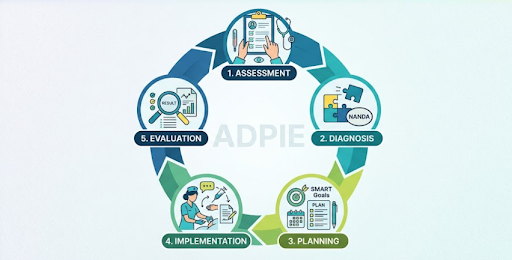
Once your data sheet is complete, you must analyze the findings to choose the correct nursing diagnoses. In a standard care plan, you cannot simply write “broken bone” or “torn ligament” because those are medical diagnoses handled by physicians. Instead, a nurse focuses on human responses to health conditions.
For a complex sports injury, you will typically prioritize three core diagnoses based on the official NANDA-I framework:
1. Acute Pain
This is always the top priority following a traumatic sports injury. It must be linked to mechanical trauma, such as tissue damage or surgical incisions, and evidenced by the patient’s verbal reports, guarded movements, or changes in vital signs like an elevated heart rate.
2. Impaired Physical Mobility
Athletes are used to constant movement, making a sudden physical restriction both physically and mentally challenging. This diagnosis relates to joint stiffness, structural damage, or prescribed medical immobilization devices like casts, splints, or knee braces.
3. Risk for Ineffective Peripheral Tissue Perfusion
Severe swelling, tight bandages, or poorly adjusted casts can restrict vital blood flow to the extremities. This is a critical preventive diagnosis where you watch for warning signs like numbness, tingling, cold skin, or weak pulses below the site of the injury.
Phase 3: Setting Measurable, Patient-Centered Goals
Every effective care plan requires clear, realistic goals that dictate exactly what you want the patient to achieve. In nursing, these goals must follow the SMART acronym—meaning they must be Specific, Measurable, Achievable, Realistic, and Time-bound.
When dealing with a high-performance athlete, it is highly effective to split your goals into two distinct temporal categories:
Short-Term Goals
These focus on immediate stabilization and comfort during the acute phase of recovery. For example: “The patient will report a decrease in pain levels from 8/10 to 3/10 within two hours of receiving prescribed analgesic medications.” Another common short-term goal focuses on safety: “The patient will demonstrate the correct technique for using crutches safely without losing balance before discharge.”
Long-Term Goals
These look ahead toward rehabilitation and independent living. For example: “The patient will regain a full, pain-free range of motion in the affected joint within six weeks of starting physical therapy rotations.”
Phase 4: Selecting Evidence-Based Interventions
Interventions are the specific, actionable steps you will take as a nurse to help the athlete achieve their goals. You cannot simply list random actions; every single step must be backed by current medical science and nursing rationales.
For a sports injury care plan, your interventions should be organized into clear clinical categories to ensure no detail is missed:
Pain Management and the RICE Protocol
During the first 48 hours following a sports injury, your primary care focus should revolve around the classic RICE method: Rest, Ice, Compression, and Elevation. You must elevate the injured limb above heart level to let gravity naturally drain excess fluid and reduce painful swelling. Apply cold packs for exactly 20 minutes at a time to constrict blood vessels and numb local nerve endings.
Neurovascular Monitoring
To prevent severe complications like compartment syndrome—where built-in muscle pressure cuts off vital blood flow—you must perform strict neurovascular checks every two hours. Assess the “Five Ps”: Pain, Pallor (pale skin), Pulselessness, Paresthesia (numbness), and Paralysis.
Collaborative Rehabilitation
Nurses do not work in isolation. Your care plan must include coordinated schedules with physical therapists to initiate safe, early mobility exercises that preserve muscle mass and prevent blood clots from forming in the legs.
The Clinical Framework Matrix
To help visualize how these phases interact, review the structural matrix below. This table contrasts the care trajectories for two of the most common sports injuries encountered in clinical rotations: acute ligamentous tears and bone fractures.
| Care Component | Scenario A: Acute Joint/Ligament Injury (e.g., ACL Tear) | Scenario B: Structural Bone Trauma (e.g., Tibial Fracture) |
| Primary Assessment Focus | Joint laxity, localized edema, drawer test observations, popping sensations. | Deformity, crepitus, precise distal pulse checks, skin integrity over fracture site. |
| Priority NANDA Diagnosis | Impaired Physical Mobility related to joint instability and severe local inflammation. | Risk for Ineffective Peripheral Tissue Perfusion related to mechanical bone displacement. |
| Immediate Intervention | Application of structural stabilizer (brace) and strict 20-minute cryotherapy cycles. | Strict limb alignment, manual stabilization, and preparation for cast or surgical fixation. |
| Critical Evaluation Metric | Achievement of localized swelling reduction and preservation of adjacent muscle tone. | Maintenance of warm, pink extremities with capillary refill times under two seconds. |
Phase 5: Executing Scientific Care Plan Rationales
The ultimate mark of an excellent nursing care plan is the inclusion of clear rationales. A rationale explains why a specific intervention works based on physiology and clinical research. If your instructor reads your care plan and asks why you chose to elevate a sprained knee, your rationale must explain that elevation reduces hydrostatic pressure in the local capillaries, which directly minimizes cellular swelling and eases pressure on local pain receptors.
Writing out dozens of these scientific justifications for every single care plan takes an immense amount of time. When you are buried under a mountain of homework, trying to balance clinical rotations with family life, it can become tempting to search for shortcuts. Rather than risking your academic integrity by turning in rushed or incomplete work, choosing to safely pay for assignment assistance from academic writing professionals can give you the breathing room you need to succeed.
Phase 6: Continuous Evaluation and Adaptation
The final phase of the nursing process is evaluation. This is where you look at your patient’s actual progress and compare it directly to the short-term and long-term goals you established in Phase 3.
An evaluation is never static because an athlete’s condition can change within a single shift. If the patient successfully meets their goals, you can officially sign off on those specific diagnoses. However, if an athlete’s pain remains high despite receiving medication, or if their foot becomes cold and pale, you must immediately revise the care plan by updating your interventions, notifying the medical team, and establishing new safety goals.
The Academic Delegation Framework
To maximize your efficiency during heavy clinical testing weeks, it is helpful to categorize your academic workload. The diagrammatic layout below serves as an operational matrix to help nursing students organize their academic priorities, ensuring they spend their energy where it matters most.
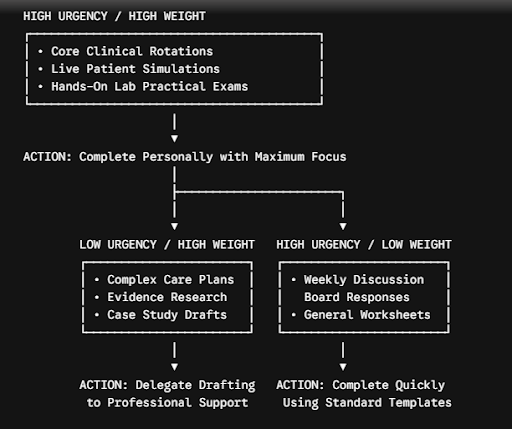
This structural breakdown highlights why care plan drafting is the ideal candidate for professional academic support. While no one can attend your physical hospital clinical rotations for you, outsourcing the time-consuming process of searching for medical journals and writing out lengthy paragraphs of rationales saves dozens of hours. This allows you to walk into your hospital shifts fully rested, alert, and ready to apply your practical medical knowledge safely on real patients.
Mastering this highly structured process is what transforms a simple assignment into an authoritative document that ensures safe, high-quality patient care throughout the entire recovery journey. Using a methodical approach to tracking symptoms, outlining clear medical goals, listing scientific rationales, and adapting to real-time changes prepares you to excel both in your university coursework and your future career as a healthcare professional.
About the Author
Ruby Walker is a seasoned educator and academic writer dedicated to helping college students navigate complex healthcare curricula. Combining years of classroom experience with professional content creation, she collaborates with myassignmenthelp to produce clear, actionable study guides, care plan tutorials, and academic performance strategies that transform dense medical theory into practical student success.
