Artificial intelligence is transforming industries at an unprecedented pace, driving demand for larger AI models, faster training times, and more powerful computing infrastructure. Modern AI clusters often consist of hundreds or even thousands of GPUs working together to process enormous datasets and perform complex calculations. While GPU performance continues to improve, the efficiency of communication between these devices has become equally important. Without a high-speed network infrastructure, even the most advanced GPUs can spend valuable time waiting for data instead of performing computations.
To meet these growing networking requirements, many AI data centers rely on InfiniBand technology. Known for its ultra-low latency, high throughput, and advanced networking capabilities, InfiniBand has become the preferred interconnect for large-scale AI and high-performance computing (HPC) environments. At the heart of these networks are 200G QSFP56 InfiniBand HDR modules, which provide the high-speed optical connectivity needed to keep AI clusters operating efficiently.
As AI workloads continue to scale, the ability to move data quickly between servers, GPUs, and storage systems becomes increasingly critical. 200G QSFP56 InfiniBand HDR modules enable high-bandwidth communication over single-mode fiber connections, supporting transmission distances of up to 2 kilometers while maintaining excellent signal integrity. These capabilities make them an essential component in modern AI infrastructures.
The Growing Networking Demands of AI Clusters
AI training workloads differ significantly from traditional enterprise applications. Large language models, recommendation systems, image recognition platforms, and generative AI applications require massive amounts of data to be exchanged between compute nodes during training. As the number of GPUs increases, network traffic grows exponentially.
In distributed AI training environments, multiple GPUs work together on different portions of a model. During each training cycle, these GPUs must frequently exchange parameters, gradients, and synchronization information. If the network cannot deliver data quickly enough, expensive GPU resources remain idle while waiting for communication to complete. This communication bottleneck can significantly reduce overall cluster efficiency.
As organizations deploy larger AI clusters, network performance becomes one of the primary factors determining training speed. Faster interconnects allow GPUs to remain fully utilized, reducing training times and maximizing return on investment in AI hardware.
Understanding InfiniBand HDR 200G Optical Modules
InfiniBand HDR (High Data Rate) technology delivers 200Gbps connectivity, making it one of the most powerful networking solutions available for AI and HPC environments. HDR optical modules use PAM4 modulation technology to achieve high data rates while maintaining efficient signal transmission.
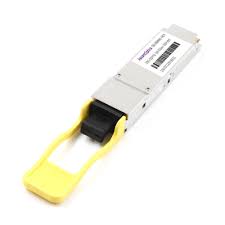
The HDR QSFP56 200G FR4 optical transceiver operates at a wavelength of 1310nm and supports transmission distances of up to 2 kilometers over single-mode fiber. Equipped with Duplex LC/UPC connectors, these modules provide a practical and scalable solution for connecting switches, servers, and storage systems within large data centers.
In addition to high bandwidth, HDR optical modules include Digital Optical Monitoring (DOM) capabilities, allowing administrators to monitor key parameters such as temperature, voltage, transmit power, and receive power. This visibility helps simplify maintenance and improve overall network reliability.
Why InfiniBand Is Preferred for AI Clusters
Ultra-Low Latency Communication
One of the primary reasons AI operators choose InfiniBand over traditional Ethernet is latency. During distributed training, GPUs constantly exchange data with one another. Even small communication delays can accumulate across thousands of training iterations, significantly increasing overall training time.
InfiniBand is designed to minimize latency through efficient transport mechanisms and optimized packet processing. The result is faster communication between compute nodes, enabling AI applications to run more efficiently and complete training tasks sooner.
Remote Direct Memory Access (RDMA)
InfiniBand supports Remote Direct Memory Access, commonly known as RDMA. This technology allows data to move directly between the memory of different servers without involving the operating system or CPU.
By bypassing traditional networking overhead, RDMA reduces latency and lowers CPU utilization. This allows processors to focus on computation rather than communication tasks. For AI clusters, RDMA significantly improves scalability and enables faster synchronization between GPUs.
High Throughput for Massive Data Transfers
AI workloads generate enormous amounts of network traffic. Training large language models often requires frequent exchanges of large datasets and model parameters across hundreds of nodes.
With 200Gbps bandwidth, HDR optical modules provide the throughput necessary to support these demanding workloads. The increased bandwidth reduces congestion and helps maintain consistent performance even as cluster sizes grow.
How 200G HDR Optical Modules Improve AI Cluster Performance
Faster Distributed Training
Distributed AI training depends heavily on communication efficiency. Every synchronization event between GPUs requires network resources. As model sizes increase, communication demands become even greater.
By providing high-speed 200Gbps links, HDR optical modules accelerate data exchange between nodes. Faster communication reduces idle time and enables GPUs to spend more time processing data, resulting in shorter training cycles and faster project completion.
Better GPU Utilization
GPUs represent one of the largest investments in modern AI infrastructure. Maximizing their utilization is essential for achieving cost-effective operations.
When networking performance lags behind computing power, GPUs may sit idle waiting for data transfers. HDR optical modules help eliminate these bottlenecks by providing the bandwidth and responsiveness required to keep GPUs continuously engaged in computation.
Improved Cluster Scalability
As AI models become larger and more complex, organizations must expand their clusters to meet increasing computational demands. However, adding more GPUs also increases communication requirements.
InfiniBand HDR networks enable clusters to scale efficiently by maintaining low latency and high throughput even as node counts increase. This scalability is essential for supporting next-generation AI workloads and future infrastructure growth.
Supporting Large-Scale AI Data Centers
Connecting Distributed GPU Clusters
Many modern AI deployments span multiple rows of racks and hundreds of servers. The 2-kilometer transmission distance supported by HDR 200G FR4 optical modules provides flexibility when connecting distributed infrastructure across large facilities.
Single-mode fiber connectivity allows operators to build larger clusters without sacrificing performance. This makes HDR optical modules particularly valuable in hyperscale AI data centers and research institutions.
Enabling Efficient Storage Access
AI workloads depend not only on GPU communication but also on rapid access to storage resources. Massive datasets must be transferred between storage systems and compute nodes throughout the training process.
High-bandwidth optical connectivity ensures that storage infrastructure can keep pace with AI workloads, reducing delays and improving overall cluster efficiency.
Future-Proofing AI Infrastructure
The pace of AI development shows no signs of slowing. New models require larger datasets, greater computational power, and increasingly sophisticated networking infrastructure. Investing in high-performance optical connectivity today helps organizations prepare for future growth.
HDR 200G optical modules provide a scalable foundation that supports current AI workloads while enabling future expansion. Their combination of high bandwidth, low latency, long-distance connectivity, and advanced monitoring capabilities makes them a valuable component of next-generation AI networks.
Conclusion
As AI clusters continue to grow in size and complexity, networking performance has become a critical factor in overall system efficiency. InfiniBand HDR 200G optical modules provide the bandwidth, low latency, and scalability required to support demanding AI workloads and large-scale GPU deployments.
With features such as 200Gbps throughput, RDMA support, 2-kilometer single-mode fiber connectivity, and advanced monitoring capabilities, 200G QSFP56 InfiniBand HDR modules help eliminate communication bottlenecks and maximize GPU utilization. For organizations building modern AI infrastructure, these optical transceivers play a vital role in achieving faster training times, improved scalability, and long-term network performance.
